We build Keys2 in Stratford, in the London Borough of Newham, and spend our weeks talking to the agencies on its high streets. This is the picture they are working in.
The national picture
- 4.7 million households rent privately in England, 19% of all households, according to the English Housing Survey 2024 to 2025.
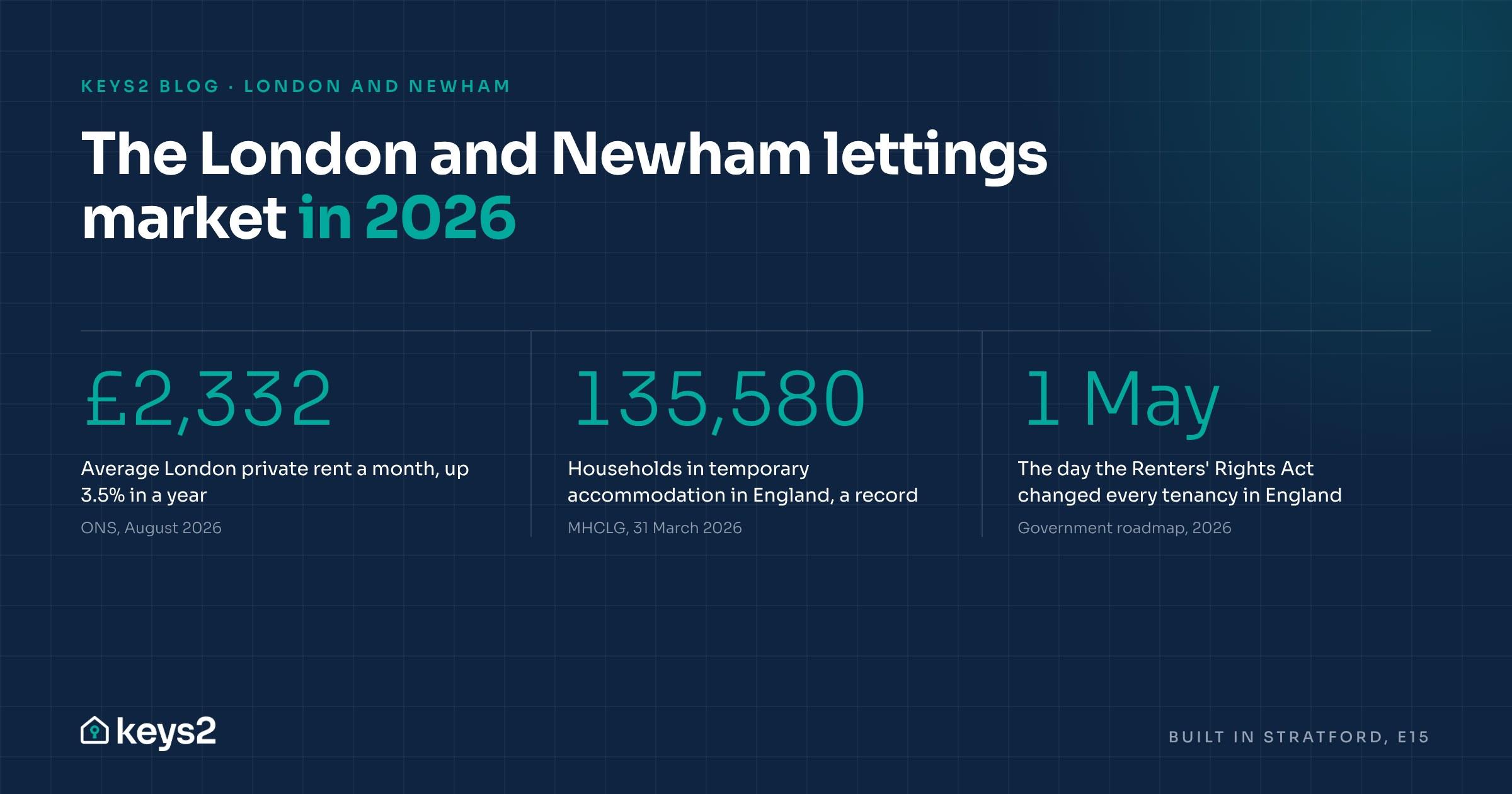
- Rents are still rising, but more slowly. The UK average private rent was £1,400 a month in August 2026, up 3.8% in a year, and England's was £1,459, up 4.0% (ONS).
- Agents carry much of the work. In the English Private Landlord Survey 2024, 43% of landlords used an agent's letting services and 18% used full management.
- Disputes are climbing. The Property Ombudsman resolved 3,119 lettings disputes in 2025, up from 1,885 in 2024, a 65% rise (TPO annual review).
The Renters' Rights Act: what changed, and what comes next
The Act's main reforms came into force on 1 May 2026 for new and existing tenancies in England (government roadmap).
| What changed on 1 May 2026 | What it means for a letting agent |
|---|---|
| All tenancies became assured periodic tenancies | No fixed end dates to plan renewals around; tenants can leave with two months' notice |
| Section 21 "no fault" evictions abolished | Possession needs a Section 8 ground, backed by evidence |
| Rent increases once a year, by Section 13 notice | Every increase needs the right notice, at least two months ahead |
| Rent in advance capped at one month | Move-in money and affordability checks change |
| Rental bidding banned | Properties are let at the advertised rent |
| Discrimination against families and renters on benefits banned | Advertising and referencing must not exclude them |
| Pet requests must be answered within 28 days | A new deadline to track on each tenancy |
What is still to come:
- The landlord register. The Private Rented Sector Database, or "Register your rental property", opens region by region from 15 December 2026, starting in the West Midlands. London landlords are due to register from 15 July 2027, with a deadline of 14 October 2027, at £65 per property per year, according to the NRLA and Mishcon de Reya. Landlords who are not registered will not be able to get most possession orders.
- A landlord ombudsman, expected to become mandatory in 2028.
- Awaab's Law and a Decent Homes Standard for private renting, with dates still to be set.
Fines for breaches go up to £7,000 for a first offence and £40,000 for serious or repeated ones (government guide). Unsurprisingly, 73% of letting professionals told a September 2026 survey that their admin workload has risen since the Act (Property Reporter).
Temporary accommodation: the pressure on councils
On 31 March 2026, 135,580 households in England were in temporary accommodation, a record high and 3.6% more than a year earlier, including 177,530 children (MHCLG statutory homelessness statistics). Almost 38% of them were in nightly paid accommodation.
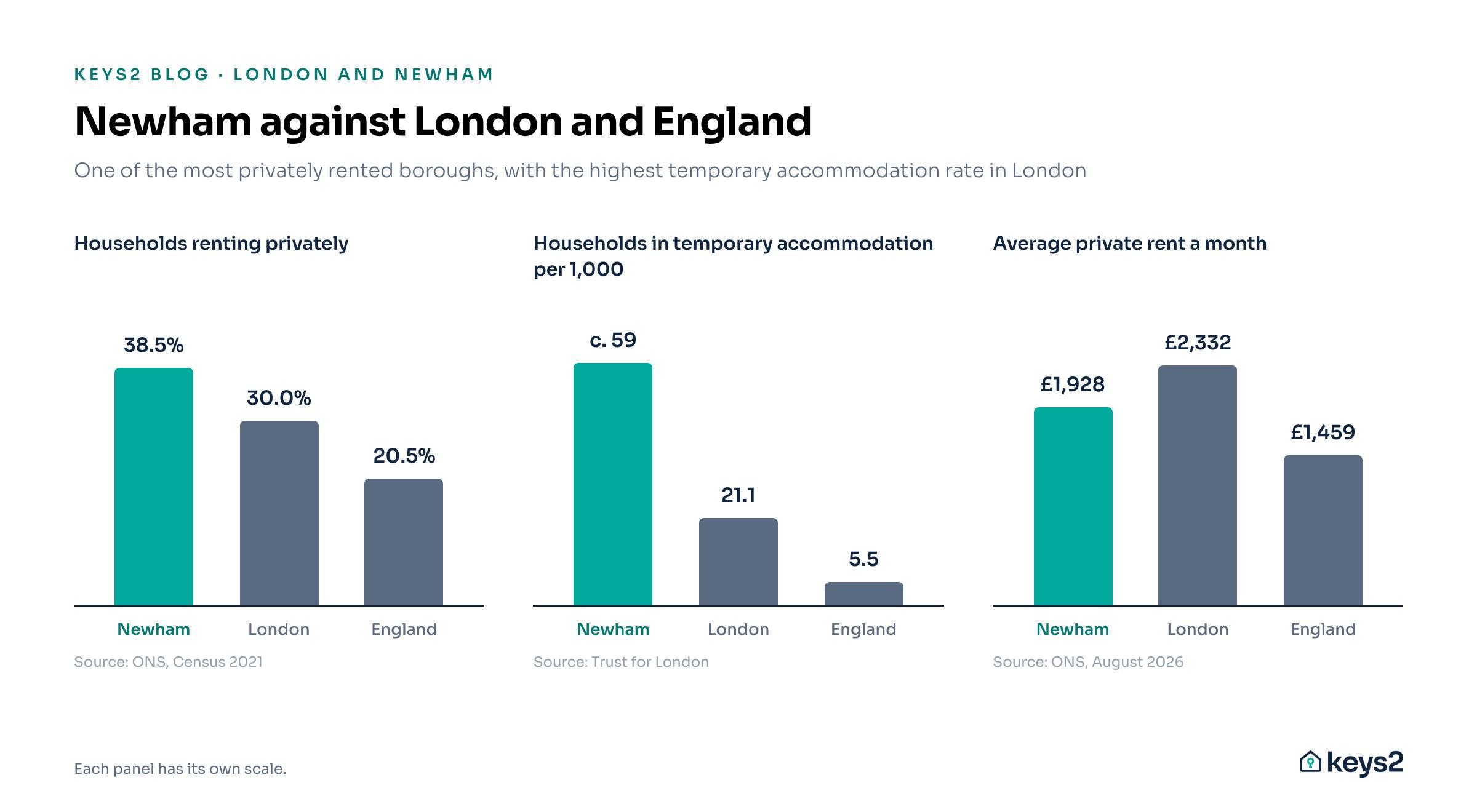
London carries the heaviest share. Its rate is 21.1 households in temporary accommodation per 1,000, against 5.5 for England as a whole. Around 75,000 London households were in temporary accommodation on average through 2025 (Trust for London). In January 2025, London Councils said boroughs were spending £4 million a day on it (London Councils).
To house these families, councils rely on private landlords and the agents who manage their homes. That makes councils one of the most important, and most complicated, customers in the London lettings market.
Newham: the borough under the most pressure
Newham has the highest rate of temporary accommodation in London, at around 59 households per 1,000 (Trust for London). The council put its own figure at about 7,500 households in mid-2025 and expected it to pass 8,000 by the end of October 2026. It says temporary accommodation makes up about £100 million of a £115 million medium-term funding gap (Newham Council).
Newham is also one of the most private-rented places in the country:
| Measure | Newham | London | England |
|---|---|---|---|
| Households renting privately (Census 2021) | 38.5% | 30.0% | 20.5% |
| Average private rent, August 2026 | £1,928 a month | £2,332 a month | £1,459 a month |
| Annual rent rise to August 2026 | 2.9% | 3.5% | 4.0% |
Sources: ONS Census 2021 area changes for Newham, ONS local rents for Newham, ONS private rents bulletin.
Licensing adds another layer. Newham's selective licensing scheme has covered privately rented homes in every ward except Royal Victoria and Stratford Olympic Park since 1 June 2023. A licence costs £750 for up to five years, or £650 for accredited landlords with an EPC of C or better, and fines reach £30,000. An additional licensing scheme for HMOs shared by three or four people has run since 1 January 2023.
And the council is a landlord's customer too. Newham's letting scheme for private landlords offers incentives, a reservation fee, a deposit where needed, 12 months of rent guarantee insurance and payment within 4 to 10 working days, in return for letting to Newham households on an assured periodic tenancy at Local Housing Allowance rent. The property must be licensed and the landlord accredited.
What this means for agencies day to day
Put together, a London agency's lettings book now carries far more than names and rent:
- More dates per tenancy: rent review notices, pet request deadlines, certificate renewals and, from 2027, landlord registration.
- Licences as well as certificates: in Newham, nearly every privately rented home needs one, each with its own term and conditions.
- More than one payer: a council, a benefit payment and a tenant top-up can all land against the same tenancy.
- Evidence on demand: with Section 21 gone, a dated record of what happened on each tenancy is what supports a possession claim.
Agencies are managing all of this, often on spreadsheets that were never built for it.
Where Keys2 fits
Keys2 is property management software built in Stratford for independent agencies like the ones on Newham's high streets. Every plan includes a compliance register that flags certificates before they expire, property licences as records, deposit tracking, Right to Rent checks and a Renters' Rights Act toolkit. For agencies that let homes to councils, the Council & Guaranteed Rent module records the council as a party to the tenancy and reconciles what the council paid against what the scheme guarantees. Plans start at £49 per month + VAT. See how Keys2 compares with other letting agent software, or book a demo on your own portfolio.
Frequently asked questions
How many households are in temporary accommodation in England?
135,580 households were in temporary accommodation in England on 31 March 2026, a record high, including 177,530 children.
Which London borough has the most households in temporary accommodation?
Newham has the highest rate in London, at around 59 households in temporary accommodation per 1,000. The council estimated about 7,500 households in mid-2025.
What is the average rent in Newham?
The average private rent in Newham was £1,928 a month in August 2026, up 2.9% on a year earlier, according to the ONS.
Do private landlords in Newham need a licence?
Yes, in most of the borough. Newham's selective licensing scheme covers every ward except Royal Victoria and Stratford Olympic Park, and HMOs shared by three or four people need an additional licence.
When do London landlords have to register on the Private Rented Sector Database?
London landlords are due to register from 15 July 2027, with a deadline of 14 October 2027, according to the NRLA. The national rollout starts in the West Midlands on 15 December 2026.
What changed for letting agents on 1 May 2026?
All tenancies in England became assured periodic tenancies, Section 21 was abolished, rent increases moved to once a year by Section 13 notice, rent in advance was capped at one month, and rental bidding was banned.